Giant Studio Sleeper on this One

This huge studio sleeper conversion conventional is one you might have seen … everywhere. It’s gone viral quite a few times, but I hadn’t seen any information on the truck itself until recently. Hopefully, after we post it on social media, you guys’ll all let us know even more about it, and we’ll update this post and give you credit for your info, like we usually do.
There’s even some photos of the inside now. These sleeper interior photos were taken by Keith Knierim. It’s his truck! The photos are at the bottom.
The main picture (above) was taken at the Richard Crane Memorial truck show at St Ignace, Michigan.
Trucker drivers and others like the big stacks and the big bedroom both on this truck, as well as the look of it. The only thing people have to say of it on the other side are about how much money a person could make with it, the studio sleeper taking up so much space and all. So Keith if you read this maybe you can let us know, and we’ll quote you on here. Also, I know you have a bunch of photos of your rig, so if you have another one you like better than this one, let us know.
Other owner-operators and truck drivers have already said even that large sleeper isn’t too big for making income if you have a dedicated run. And from other big sleeper semi units we’ve done write ups for in the past, I can tell you the owners of these trucks pretty much all say the weight is not as much as many people might think it is.


The Original Bubble House … Yes, They Actually Made and Sold These in the 70s!

Some of you might be familiar with the bubble rooms that were popular last year — clear inflatable rooms you could buy for around 5K and set up in your yard or even camping as a sort of tent.
Well, guess what? They actually tried this in the 70s, too. Yes, that era of creativity produced the idea as a rising product, featuring ads in magazines with young happy people setting up and inhabiting the tiny house bubble.
The L.A. company behind it was called Chrysallis, and the ads put the bubble house in terms of the “most revolutionary concept in mobile living since somebody invented the trailer.” Well, you can’t really give the ad writer much credit for research, but I guess he didn’t worry too much about how the RV trailer was invented.
The tiny house bubble fit into a 42 inch by 60 inch by 12 inch box when it was deflated and folded. When it was filled with air (which took about 8 minutes), the tiny building was almost 500 square feet (and was 25 feet in diameter).
Of course, you had to keep pumping air into the bubble to keep it fully inflated, but the advertisers put this in terms of a constant gentle current of air swirling around the new house / building.
It cost just under $2,000 in 1972 U.S. dollars.
Stylish Future Trucks

This future truck concept has some style, it’s called the Ivenco concept truck, and its a Grabcad design by Ivan Tarantini, and it got a good amount of appreciation from the designers on Grabcad.
“It could be the truck of the future,” stated the future semi tractor designer about this model.
The truck design was also picked up by other online game/simulator people, like on Modhoster (click here), where they modified it to be a truck for their farming community.
And here’s another future truck concept, called the OEX-B (pictur below), designed by Hamid Bekradi. This one is designed with overlanding in mind.
Among the standout features of this motorhome RV, future style: huge, rounded windows all over the place, a spare tire you can always keep an eye on (and a bumper that would definitely pierce anything it crashed into, and solar panels that expand as a sort of wing atop the vehicle.
Oh, and this motorhome design also has a sun-deck.
Visit Grabcad digital design forum (click here).

This Truck Has A Huge Load

Truckers, how would you write this one up? Although it might be a little difficult to get away with something like this big overloaded trailer in North America, apparently in some parts of Asia it’s possible.
Did you count those trucks stacked on that trailer? And how many are hanging over the back? This is a street in China (or perhaps Mongolia, which is just north of China) somewhere. In some early posts on the net it was attributed to be in Japan, but the Japanese blogger at Xiongmao-fanfan (click here, but its in Japanese) pointed out that it.
Here’s another one, although perhaps not as heavy, of a truck loaded with a bunch of plastic containers.
If anyone wants to share a similar photo, we’ll add it in here as well. We’ll be checking your comments on the social media posts, so if anyone wants to see more, check back on this page later.

Everything Comes Via Trucks

Got time to do the math on how many wheels there are on this oversize load tractor-trailer moving along the highway? Everything or pretty near everything comes by way of trucks, even trains. And by the way, truckers out there, if you want to read more about trains, you can visit RailPictures (click here), where this great shot by Simon Barber was shared.
Is it just because I live in Canada that I’ve never seen anything like this on the highway — the opposite of intermodal transport, as Kevin Beeler put it? Owner-operators and drivers out there, what’s the biggest, heaviest load you’ve put on a flat-bed trailer?
So what’s happening in this photo is a train came off the tracks — 8 locos were involved — which was caused by a faulty switch loop. And the one in this trailer picture (above) is actually one of the ones that came out of the cornfield meet gone awry in fairly decent shape.
So did you look at that photo above and count the wheels?
About this trucking method, Bruce Kellet had a bit to say: “All the Pilbara Railway Operators have been successfully transporting rolling stock using this method since their inception the mid 1960s.
“There are only two viable methods of transportation, road and sea due to the remote Pilbara Rail network being physically isolated a vast distance from the ex State Government rail network connecting Perth. The heavy axle load and oversize loading gauge prevents this equipment using this trackage. Road is the only option on land at this time. They say everything in Texas is big. I totally agree, but come and visit the rugged Pilbara Region of Western Australia one day.” Well put!
Gettin er done!
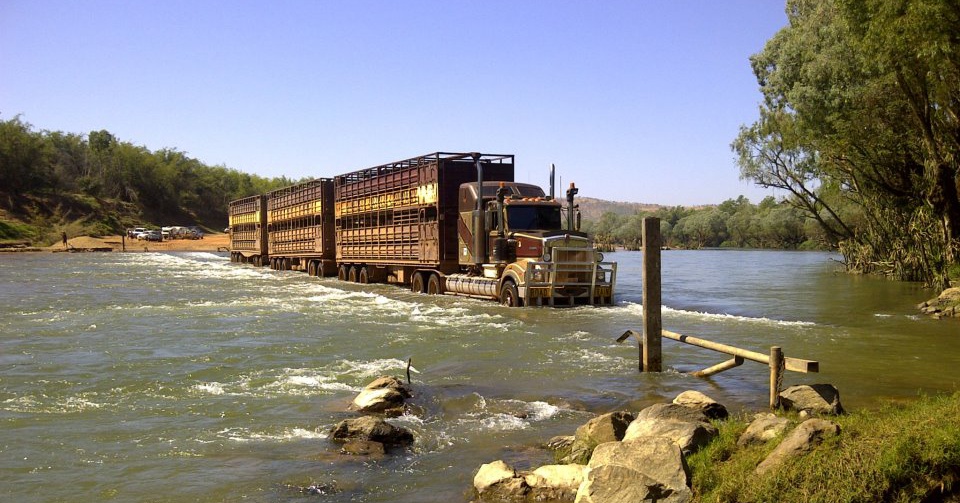
What we have here, truckers, is a small Australian road train crossing the Daly River in the Northern Territory. Those three trailers behind that Aussie tractor: for picking up cattle to take to market, and it was taken by Ask An Aussie Farmer, a very interesting and valuable initiative undertake by a group of real farmers who will answer questions people have about their “food and fiber.” (visit them click here).
Road trains are pretty famous worldwide among truckers, and whether you’re an owner-operator or driver who would like to try out pulling 4 or 5 trailers or you’d rather not, they are an interesting way of doing things, and maybe they’re especially suited to Australia, although the country does also have a fairly extensive cross-country train system (east to west and along the west coast, as well as north to south.
Ann Britton commented on the AAAF site, and her point was a good one, I think you’d agree: “When you thank a farmer for your next meal, thank a livestock truckie too I reckon, good livestock truckies are worth their weight in gold, I treasure ours & tell them so, cause I know our stock will be looked after. Happy Easter to all the Truckies on the road, keeping our nation moving.”
In some places in Australia, though, it seems, road train trucking is not in practice. In some areas they aren’t allowed, and they do side loading, which is supposedly easier.
How would you like to try a long haul using this future truck?
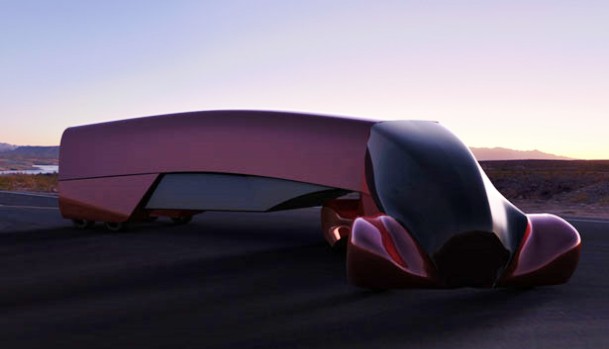
When it comes to future trucking, we probably don’t know what’s in store for the highways at all. We currently know that truck shippers are still in full swing and many appreciate their services. But we can guess and look at various future truck designs, and some are smooth and streamlined like this one, some are boxy and showy, some are just slightly modified extensions of what owner-operators and drivers are using today.
Now this design might have a few things people might question as far as using as a daily shipping truck (looking at the photo above), but what about liking to drive it. Would you like to drive a truck that looks like this. I also get the sense it would be quite aerodynamic.
The designer is John Shercliff, and he based his truck concet on aerodynamics, partially in order to increase fuel efficiency at high speed travel.
Also, the wide arches of the truck are intended to help it grip the road. And did you notice the canopy from the photo? The intention there is to incrase the driver’s range of vision around the truck.
Can you guess from that photo one of the inspirations for this design? Would you believe ‘Formula 1’? Yep, Shercliff wanted to incorporate American power and strength with Europeann performance and style, with the look of a racer.
The truck is to be powered by hydrogen fuel cells for reduced carbon emissions.
Future Truck with some Unusual Features
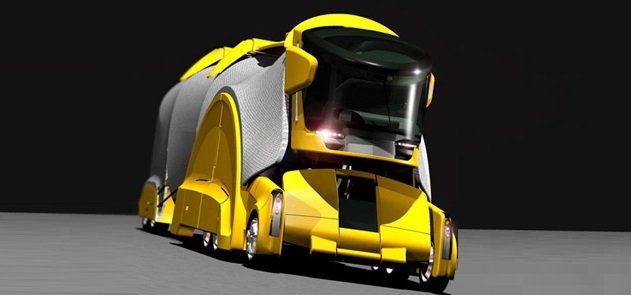
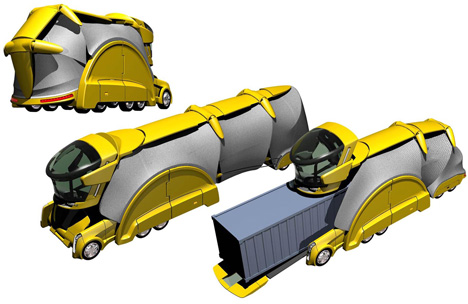
This future concept transport truck has several interesting features not currently being used anywhere in the trucking industry. It’s a design by Chinese vehicle designer Haishan Deng, and it’s being called the “Bionic Chameleon Concept” truck.
So what’s unique about this future truck? Can these ideas help owner-operators and drivers get the job done?
Besides increased fuel economy thanks to the weight of the canvas material used on the truck (which weighs half of what the material used in conventional trucks use, although the durability might be questioned), this future trucking machine uses a system of expandable units and unusual sliding technology.
The cargo size can be adjusted because the body is segmented, and segments can be taken out.
The load of the truck seems to be accessed by the front (see the image at the bottom of this article). And the cab of the truck (see top image) seems to be two main parts: one is the seat of the drivers area, and one is the entire window-and-roof area, which lifts up for the driver to enter.
The whole cockpit lifts up to access the interior cargo bay.
What do you think of this future transport vehicle (it’s not a semi, even, its a single piece truck, like the way a motorhome is built sort of).