A crochet market bag? Most people seem to be trying to cut down on using plastic bags (in some places in Europe, they’ve actually made plastic bags illegal in some stores), and we’re using more cloth bags. Some people forget them every time and have to buy more, some people always have some stuffed in their purse, but crocheters now have a new option: make a crochet project of their market bag.
That’s what Michelle at My Poppet did. Look at that crochet bag up top. It has a tighter crochet for the bottom to keep everything in and secure, but a looser crochet for the sides, so that you can see in, for lightness, for stretch, and whatever other reasons. Then a nice handle. And the colors can be your own.
Featured music of the day:
To subscribe to this musician, click the red button:
Crochet materials for this project:
• 2.5 balls kitchen string for the bag body
• 1 x 50g ball 8ply/DK cotton in contrast colour for the base and handles
• 4.5 mm hook
• Open Stitch marker
Stitches used (quite a few on this particular project, and you might expect it to be so — it comes from a talented crocheter):
slip, chain, single, double, and back loop only
First you crochet the base, going around your starting point and crocheting rows of border. You’ll have what looks like a short long bowl at the end of this. Then you create the bag body, and the top border of this with a tighter crochet again. The strap is crocheted much the same way the top border is done. For the complete pattern visit My Poppet (click here).
This change purse crochet project is from Spanish crochet blogger Lanas Y Ovillos, What’s probably most striking about it is the simplicity and just nice look of the purse.
Lanas y Ovillos is a Spanish-language site, and the crafter does create tutorials, but they are in her language. However, for this crochet purse, anyway, the video is still pretty easy to understand. “Primero” means first and “ultimo” means last or final, and “pontos” means point. If you can count “Un, Dos, Tres, Quatros,” you can understand what she’s doing.
Also the directions of the pattern are written in English.
Materials needed:
2 colors of yarn
crochet needle
That’s it. To see the pattern and tutorial, visit Lanas Y Ovillos (click here).
Girly Shrug (free pattern)
This “sassy little” crochet shrug is something you don’t see people wearing every day. You could see how light these would be to carry around though. You could use them with other clothes you already own, shirts and dresses both, to add variety. It will also cover up a little more if you want to go from a more relaxed to a more reserved setting. Interesting crochet project idea.
This one comes from the handiwork of crafter Sarah at Ball Hank n Skein. Actually I think we’ve featured her work before as well. She says this crochet shrug is “Great for evening wear, weddings, date nights, and more.”
The project will take about 2 hours or less, according to the pattern.
Skill level: easy
The pattern is for various sizes of bust, from 32 to 40.
Required:
Yarn, hook (H — 5mm)
How this crochet project is made:
Start by making rows, then fold the rectangular piece of fabric in half to form armholes, join the corners and you have it. For the free pattern, visit Sarah at Ball Hank n Skein (click here), and the photo is by Amanda Tipton Photography (click here).
Knit Look Crochet Cowl (free pattern)
Blending crochet hobby with the look of knitted stitches, this knit-look crochet cowl was created by crafter Delia. The photo you see above was created for “scarf week.” Want to make your own?
This crochet project is made with a special stitch called a “camel stitch,” which is apparently a good one to know. Delia said it was her new favorite after making this cowl. In turn, she learned it from a crocheter we’ve written about at Blogunity before, Ami at All About Ami.
The “camel stitch” is also called the V-stitch by crocheters.
For this DIY crochet cowl, you will need:
Super Bulky Category 6 Yarn – 2 skeins or about 135 total yards
N15/10.00 mm hook
yarn needle
(For the cowl in the photo at the top, 1 and a half skeins were used.)
Stitches used: Chain, slip, half double
Delia also noted that she liked the effect of this special “camel stitch” because of the inside: it looks almost like purl stitches, she added. For her pattern, visit Delia Creates (click here).
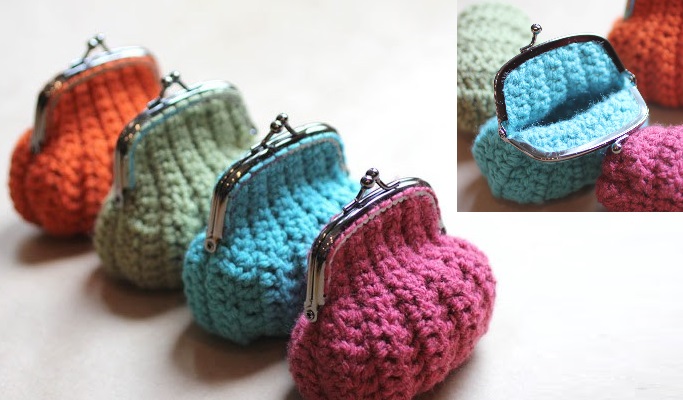
How about these colorful little change purses. These are things you can carry around in your large purse, and they’re a reminder that you can crochet your own things, every day. Also, nice little conversation starters every time you have to pull them out to pay for some small item or a tea or coffee or something.
These crochet coin purses pictured above are based off of the Hook Hound pattern on Etsy, which is a $6 pattern, and the photos are by Sarah at Repeat Crafter Me, who used that pattern. She wrote that she couldn’t find a pattern that she was happy with for free so she got the Hook Hound one. It does look like its a nice pattern, so that might be your option.
Here at Blogunity though we also always like to find a free pattern, and after quite a bit of research, we came up with one pattern similar for crochet purse projects.
It’s by Made To Treasure, and it also involves a purse that’s wider at the bottom and closes by means of a metal frame (she got hers in Dubai, so I won’t say where you can pick these up). However, Sarah said she got her frames (the ones in the picture above) from JoAnn’s fabric store (they’re “Everything Mary” brand).
The details of the Hook Hound crochet pattern are only available in the pattern purchase, and there is no materials list for the free one, but there is a full pattern / tutorial for it. To get the paid pattern pictured above, visit Hook Hound (click here) or look at what Sarah did with it (click here). For the free Made To Treasure pattern (click here).
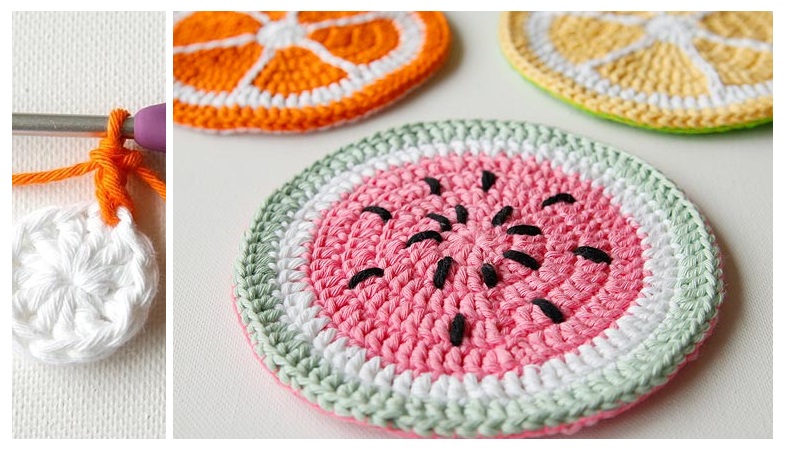
Potholders are something any crocheter — beginner or advanced — can work on, because they’re small, useful crochet projects for around the home. This idea takes the standard crochet potholder and adds a creative touch — They look like the rounds of food items like oranges, watermelon and lemon. This works great it seems, because food is a kitchen theme, and the potholders will be in the kitchen. They also get a chance to add some color and personality to your kitchen environment.
Plus, of course you can give these as gifts. Imagine how your friends would receive these. Take another look up top at the picture and think how you might like to have someone make them for you! This crochet idea is the handiwork of Marinke, also known as “Wink,” who writes at A Creative Being, but published about her crochet potholders at Tutsplus.
Stitches used for this DIY crochet project:
Double and slip stitch, and chain.
Crochet materials needed:
Yarn (I used Drops Paris cotton)
Crochet hook (4mm)
Darning needle for sewing in the ends
Felt
Sewing needle
Sewing thread (not shown)
Scissors
How its made (the orange one, for example): start out by crocheting a magic circle. Then crochet around and form a disc. Then switch colors from white to orange and continue to form the circle until you want to add the white circle, after which you add the final orange circle and then sew in the white lines.
Finally, you sew in the felt pad on the back. For the complete lesson tutorial, visit Tutsplus (click here), and visit Marinke at A Creative Being (click here).
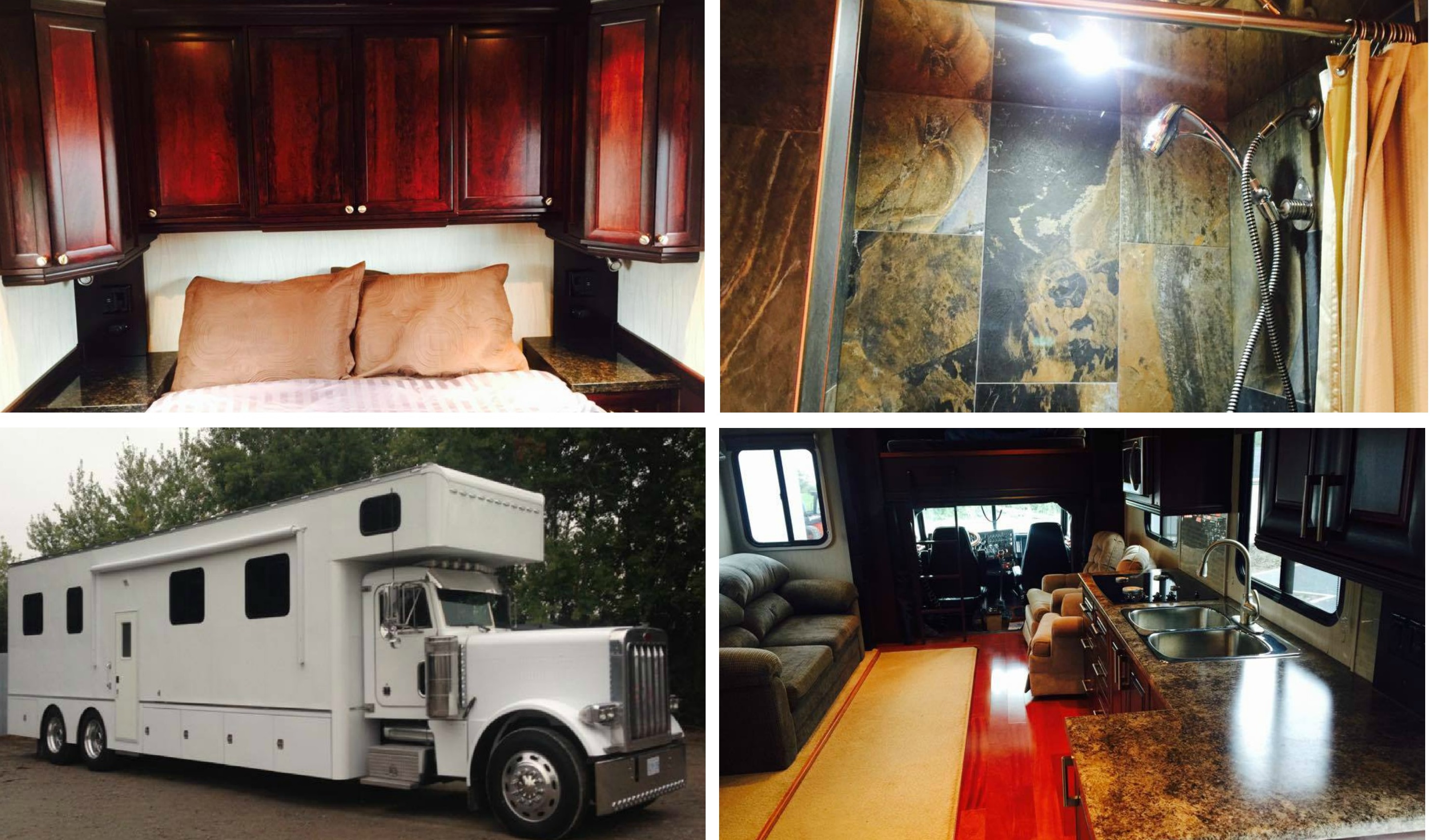
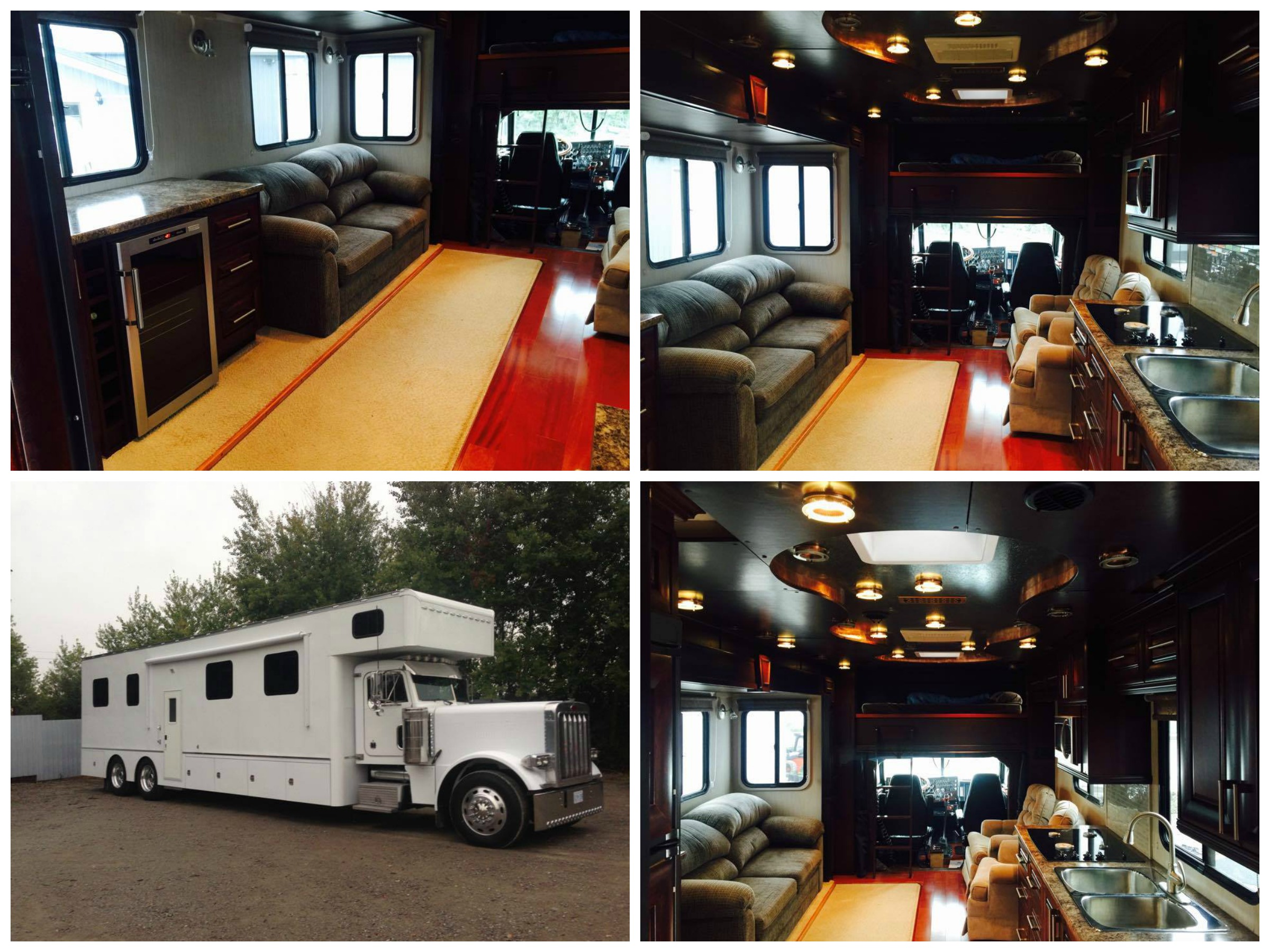
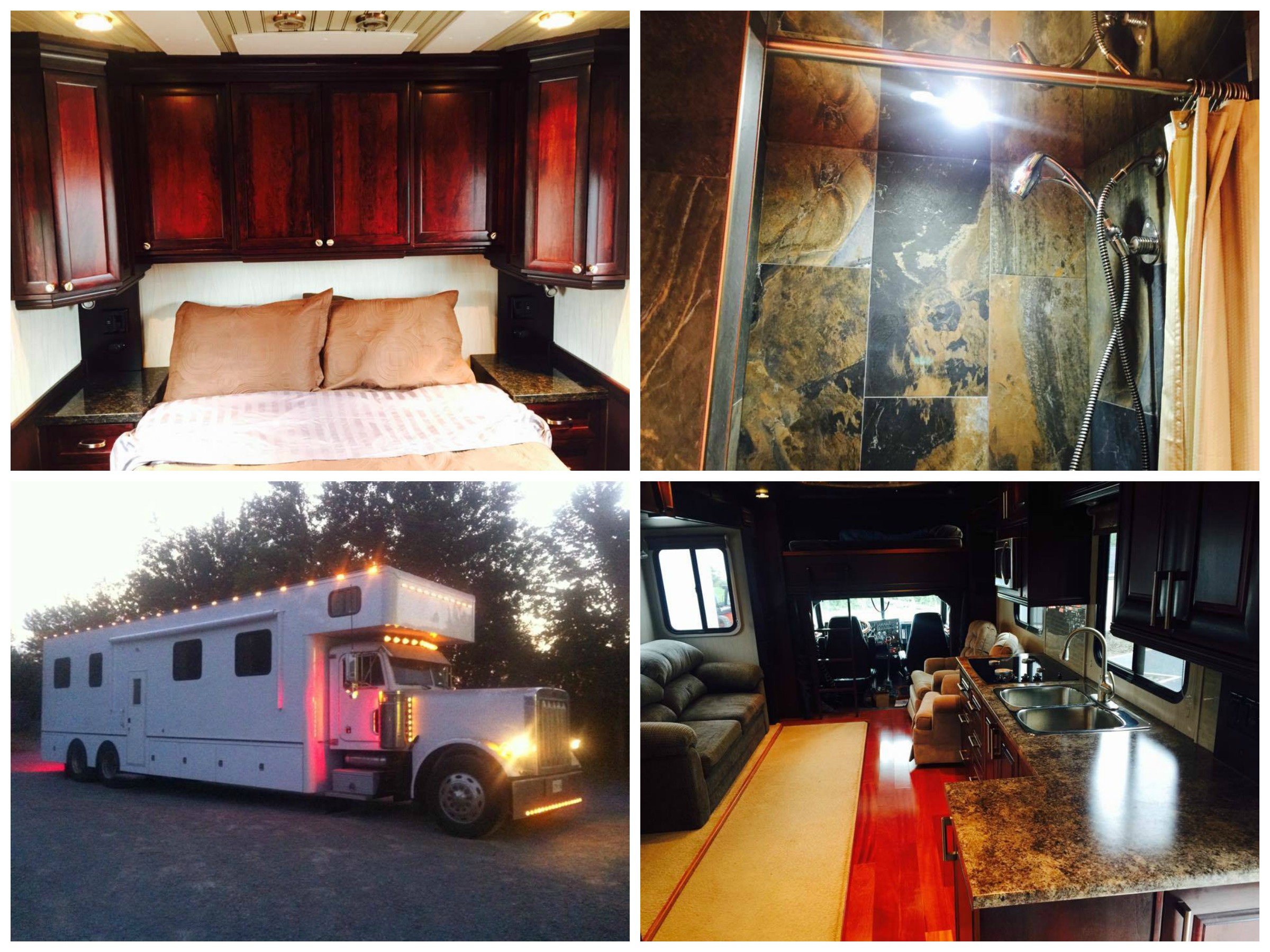
This big white RV is a custom motor coach built by the owner himself Al Scetto (who is a member of the Planes, Trains Page!). Isn’t it something? Inside and out. But in particular, I don’t think I’ve seen anything like some of the features inside this custom coach.
“This is a custom motor coach that I built myself over a five year period, inside and out,” Al wrote to us about his truck. “Back when I was about 21 or so I was working as a truck driver for my uncle at Keena truck leasing & transport in Bolton Ontario and thought I wanted to a truck driver but that never happened. Instead I chose to get into carpentry / woodworking and that’s where I am today.
“So periodically I will still drive truck for him to Florida / Texas. On one trip to Florida about 10 years ago I had seen one very similar to the one I built and I took a tour of it and thought I had to have one. So I started looking for a tractor and found one in Barrie Ontario that another friend of mine had and was selling. I purchased the truck from him and it sat in my yard for 2 years before I began the project because I had to build a shop to house the project. So after 5 years of building , this is the result
“We’ve been using it now for 3 years or so.”
Some specs on this custom motor coach:
– Double framed from transmission to the back
– Year- 1993
– Model- 379
– Power- 425 cat
– Trams 13 speed
– Wheelbase -379″
– Length -44′ bumper to bumper
– Sleeps- 6
– Interior- hardwood front to back, ceramic tile shower,
– All cherry wood cabinets and finishes throughout
– Appliances include, fridge, wine fridge, gas cooktop,
– Microwave
– All Alluminum body, sprayfoam insulated on all walls, ceiling and floor
Thanks again for sharing this great custom motorcoach with us, Al! It’s a one-of-a-kind, and it gives us an idea of what a guy can do building his own custom RV! Here are a couple of high-quality collages of Al’s project (view on a large screen to get the full idea).
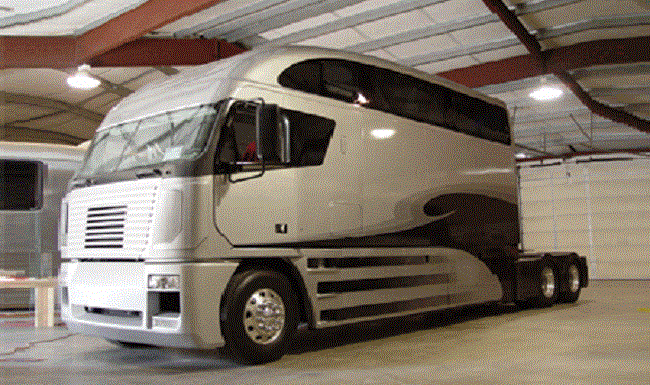
With build costs from between around $400,000 to well over a million, you might expect these Argosy custom motorcoaches to be rare. And they are. I’ve only seen the one like this, and a few others that are somewhat similar.
That price tag includes custom luxury motorhome interiors that can cost a million dollars.
This is the work of Twins Custom Coaches. I’m not sure if the custom builders are still building, because the old link to their website no longer works, but judging from some old material on the twins, they were active until not very long ago.
The unique part of this Argosy motor coach is it has a floor plan developed by the twins Mickey and Todd Larson (of Wisconsin and then Orange, California) with their father, the custom builder they learned from, Glenn Larson, who had driven a Century-Class Freightliner with his wife, Shirley, for years.
What they did to make this custom motor home:
– Cut and stretch the frame rails to a 325 inch wheelbase
– Moved the drive train back to the differentials
– Couple them with a 22 inch driveshaft
– Locked the cabover’s cab down permanently
– Built the body of the cab sleeper extension
– Attached aluminum skins to the walls
– Attached a giant one-piece fiberglass roof cap
They then set to designing (with a designer buddy) and completing the luxury stylings of the home on wheels.
To visit Twins Custom Coaches, (click here) but it doesn’t work for me. If you know how to find their new site if they have one, let us know. To read more about custom Argosys, click here.
This custom Freightliner Argosy was a project at Paradise Coach Interiors, who are as you might guess a custom coach / motorhome build company. They’re based in Coberg, Oregon, if anyone is curious about doing a custom interior or rebuilt there.
This article has moved to WheelsList.
Toterhome Upgrade in a Day
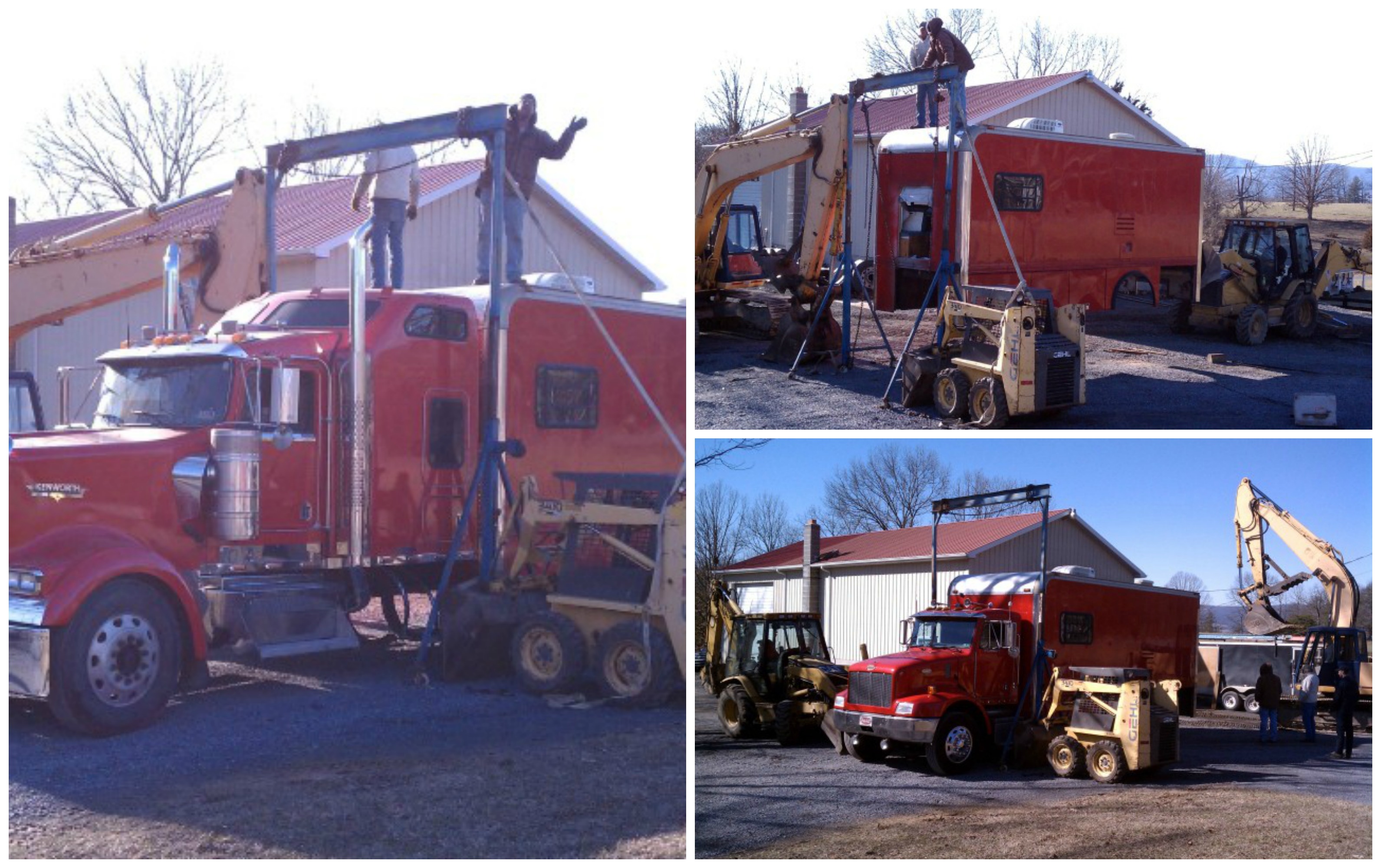
This is the toterhome of the Wolf Racing Team, out of Moorefield, West Virginia, and they recently — after swearing off doing anything like the huge task carried out when they first built their toterhome — upgraded their toterhome. It only took an afternoon this time, though.
The reason for going back to the task: the team wrote, was that they didn’t like being passed. Didn’t like it on the track and didn’t like it on the highway getting to the track. And this upgrade was done about three years after the initial build, so maybe enough time had passed since their team members were uttering “never again.”
So they did this upgrade and added, as they say, a few hundred horsepower to their toterhome.
In an afternoon. They wanted to keep the work they had already done in 2010, so they didn’t start all over. They just lifted the living quarters box off the old truck and placed it on the newer one.
Luckily for those interested in things like motor home conversions and upgrades, they posted photos.
Visit Wolf Racing Team to see what they’re up to these days (click here).
Custom Toterhome
This bright red toterhome — formerly used in racing — came across our eyes and we decided to do a write up on it. It’s a truck and trailer that belongs to a fellow who decided to sell the unit due to retiring from the family racing business.
Due to the nature of the truck sale, he said the truck also came with a lot of racing equipment and parts.
It’s a Freightliner chassis, but even though the fellow did list a lot of the features of the truck, he didn’t mention the truck model.
Truck specs:
Engine: Detroit C60
Transmission: Eaton M-10
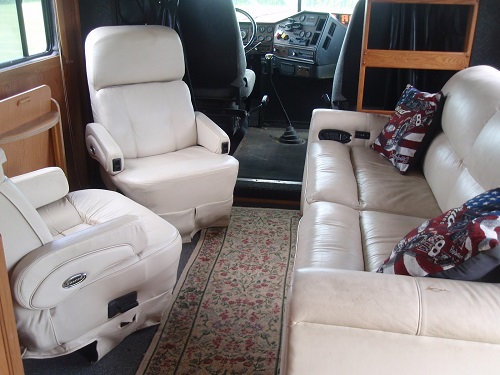
Sleeps: 6 (the sleepers are accomodated in 2 bunks, 1 over the cab and a couch)
5500 Onan generator
Wheels: Aluminum Alcoa
Lots of toterhome features, like a full bathroom and shower, good kitchen set-up, lots of cabinets, exterior storage compartments,
As you can see, it also has a 42 foot fifth wheel trailer, and the trailer is done up like a shop.
He didn’t sound like he was in any rush to sell, but was considering offers on this fairly luxury motor coach toterhome. Visit B Doocy (click here).
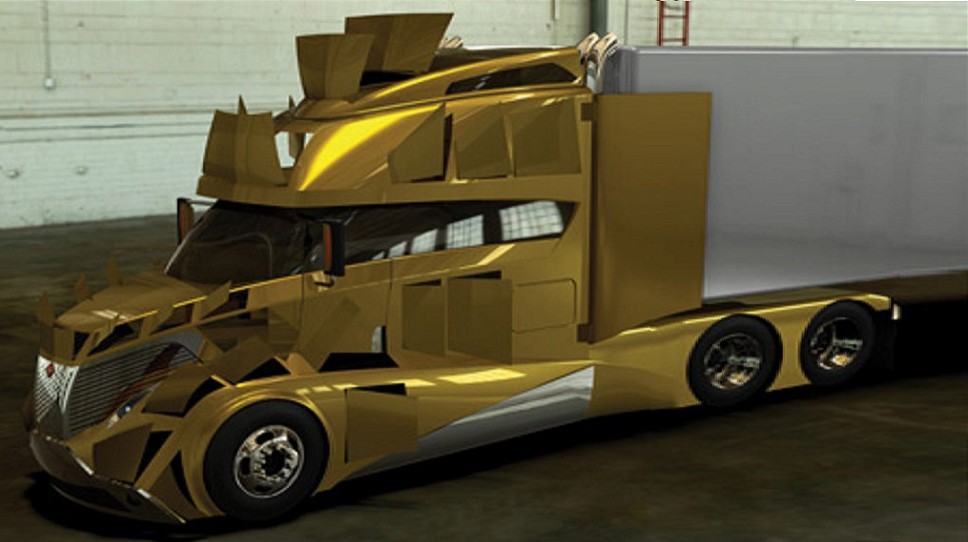
This future truck design was created by college designer Austin Fodell, and it shows a conventional semi tractor of a unrecognizeable make, and was designed by Austin as part of the “Create Fuel-Efficient Truck of Tomorrow” project undertaken by the College for Creative Studies in Detroit, Michigan.
The goal: slash fuel consumption. How much? The designers aimed at reducing fuel expenses 10 to 20 percent. Emissions were to be reduced by the same amount.
The real-life reasons behind the project are the government’s impending changes to regulations in the transportation industry. The government wants more fuel efficient trucks — we’re referring here to the U.S. Department of Energy’s 21st Century Truck program.
15 CCS students took part in the project, which is actually a join program with the design college’s corporate partner, Meritor.
“As professionals in the field, we know that it is important that students stay abreast of any new laws. Designers must look at the entire picture when designing a vehicle, not just the aesthetics,” noted Mark West, professor and assistant chair of MFA Transportation Design at CCS.
Because technology is constantly allowing us to improve the way we do things, and because the environment has reached its limits in some respects, although we still would like more from it, vehicle designers have new challenges ahead of them.
“The students closely considered the vehicle’s life expectancy, hybrid powertrains, integrated solar panels, highway safety, driver comfort and safety and serviceability in their design.”
 " >
" >